
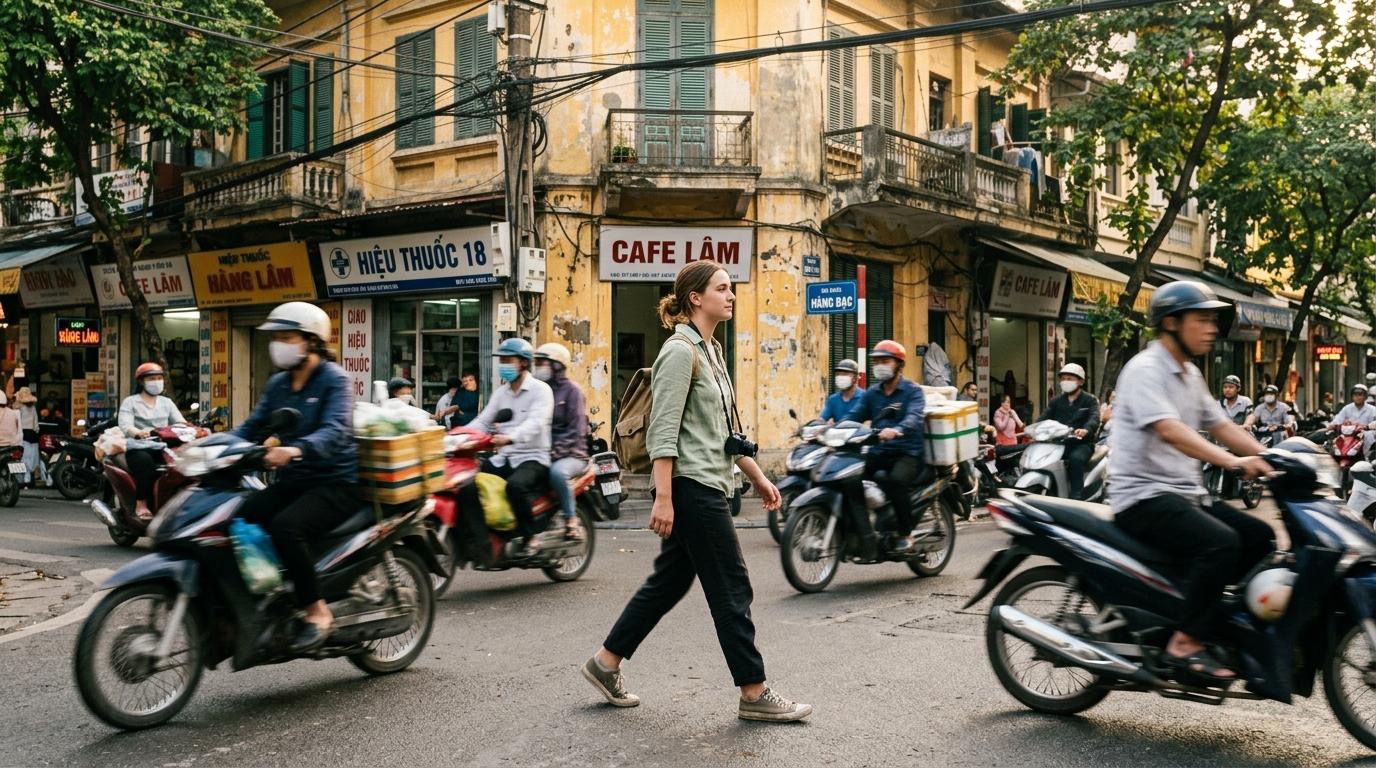
For almost every first-time visitor to Vietnam, the single most intimidating moment happens within ten minutes of leaving your hotel lobby: standing on the curb of an Old Quarter street, staring at an unbroken wall of five million motorbikes.
There are no pedestrian walk signals. Painted crosswalk lines appear to be treated as decorative street art. Buses rumble past, horns beep in rhythmic staccato bursts, and nobody seems to be slowing down.
Videos of tourists hesitating at Hanoi intersections have racked up tens of millions of views on social media for good reason. It looks like reckless chaos.
Yet, when you look closely, people cross these streets all day long without drama: elderly grandmothers carrying metal pots, six-year-olds walking to school, and street vendors balancing heavy baskets of persimmons on shoulder poles.
Hanoi traffic is not random disorder; it operates under a fluid, unspoken set of physics. Once you understand the rules of the road, stepping off that curb transforms from a moment of panic into an empowering local ritual.
Here is the exact pedestrian playbook used by locals to cross any street in Hanoi safely and calmly.
1. The Core Philosophy: "Be Like a Rock in a Flowing Stream"
In Western traffic systems, safety depends on rules and right-of-way. Cars stop completely when a pedestrian steps onto a painted zebra crossing.
In Vietnam, traffic operates like a liquid river. Motorbikes do not stop for you—and you should not expect them to. Instead, riders calculate your trajectory seconds in advance and steer smoothly around you.
WESTERN PEDESTRIAN LOGIC:
Wait for a gap in traffic ➔ Step onto street ➔ Expect vehicles to halt
VIETNAMESE PEDESTRIAN LOGIC:
Step onto street ➔ Maintain a constant, predictable pace ➔ Scooters flow behind and in front of you
Think of yourself as a solid, visible boulder in a gentle mountain stream. The water does not crash into the boulder; it parts and bends around it.
The moment the system breaks down is when the "boulder" behaves erratically—jumping backward, sprinting, or freezing midway across the road.
2. The 5 Golden Rules of Crossing the Road
If you remember only five things when walking in Hanoi, keep these principles in mind:
Rule 1: Never, Ever Step Backward
This is the single most critical rule in Vietnamese road safety.
When a motorbike rider approaches you from thirty meters away, their brain instantly plots a trajectory: "This pedestrian is moving forward at one meter per second. I will steer behind their heels."
If you suddenly take two steps backward out of fear, you jump directly into the exact path the rider planned to use to avoid you. Commit to moving forward. If you feel completely overwhelmed, stop moving and stand entirely still, but do not backpedal.
Rule 2: Walk at a Steady, Predictable Pace
Do not run, and do not dart forward to beat an approaching scooter.
Sprinting makes your speed unpredictable. Walk at a steady, measured pace—about the speed you would stroll through an art museum or a grocery store aisle. An even walking rhythm gives every driver on the street the time and distance needed to adjust their handlebars.
Rule 3: Use Gentle Eye Contact and "The Low Hand"
Eye contact connects you to oncoming drivers. Look toward the riders approaching from your left, but do not glare or make panicky gestures.
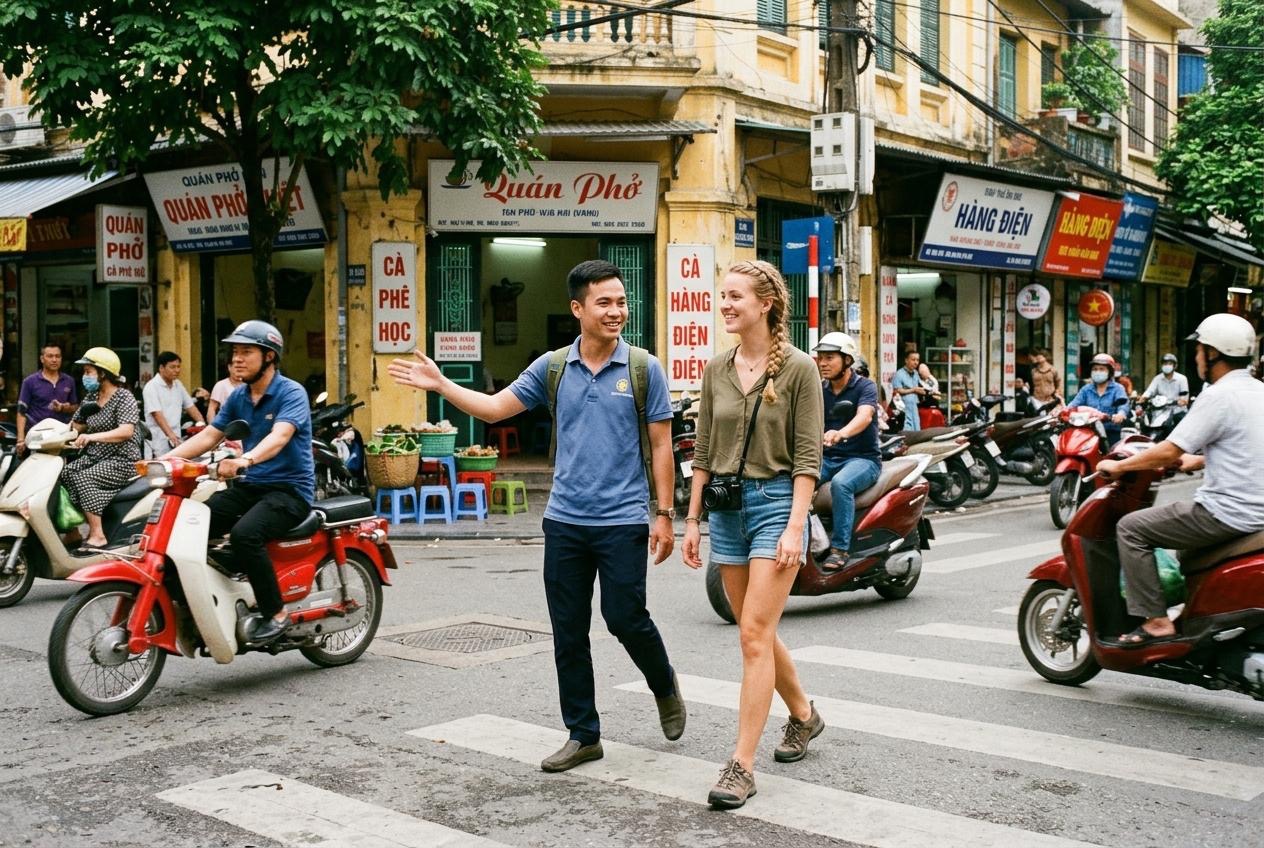
Locals use a subtle gesture: extend your arm slightly outward at waist height, palm facing down or tilted toward traffic, making gentle, rhythmic downward motions. This quietly signals: "I am here, I am crossing, and I see you." It is not an aggressive stop command; it is an acknowledgment of shared space.
Rule 4: The "Human Shield" Technique (Walk With a Local)
If you are terrified on your first morning, find an elderly local resident, a hotel bellman, or a fruit vendor waiting at the curb.
When they step off the pavement, position yourself on their outside shoulder (away from oncoming traffic) and match their stride step for step. Local riders read the movements of Vietnamese elders with instinctive deference.
Rule 5: Cross as a Compact Unit (For Couples & Groups)
If you are traveling with a partner or friends, do not walk in a loose, broken single-file line across four meters of road. That forces scooters to guess between multiple moving targets.
Stand shoulder to shoulder, lock arms or hold hands, and cross as one solid, cohesive block.
3. What Traffic Signs and Crosswalks Actually Mean
To navigate Hanoi without confusion, you need to understand the practical hierarchy of the road:
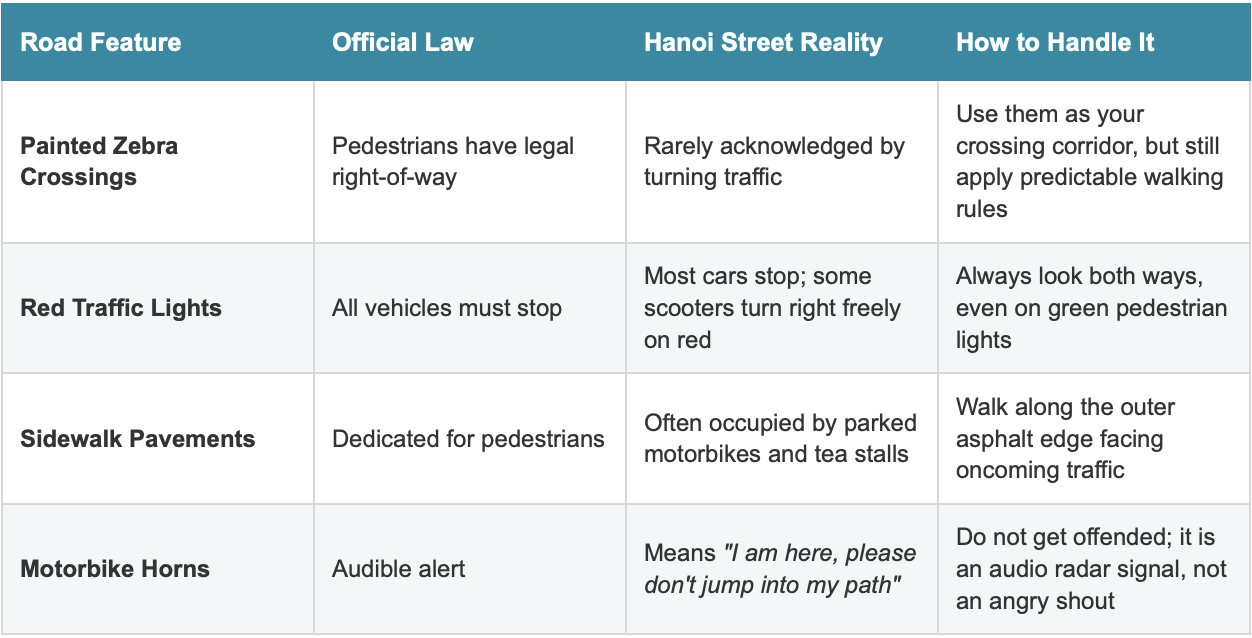
Pro Move (Understanding the Horn): When a scooter honks behind you in Hanoi, it rarely means "Get out of my way, idiot!" In Vietnamese street culture, a short tap on the horn is a polite safety ping: "Heads up, I am passing on your left." Treat it as helpful spatial awareness, not road rage.
4. The 4 Most Intimidating Crossings in Hanoi (And How to Handle Them)
Certain intersections in Hanoi test the nerves of even seasoned travelers. Here is how to handle the four most notorious spots:
1. The Hoan Kiem Fountain Roundabout (Dinh Tien Hoang / Hang Gai)
This large five-way junction connects the Old Quarter directly to the northern tip of Hoan Kiem Lake. It has continuous circular traffic flow with no traffic signals.
- The Tactic: Do not try to cross the entire roundabout in one long diagonal march. Break it down into two legs: first cross to the central pedestrian island near the fountain, pause to orient yourself, then cross the remaining lane to the lake promenade.
2. Trang Tien & Ngo Quyen Intersection (French Quarter)
Because streets in the French Quarter are twice as wide as Old Quarter alleys, vehicles travel noticeably faster here (35–45 km/h compared to 20 km/h in the alleys).
- The Tactic: Cross strictly at the painted lines near the Metropole Hotel. Wait for a green light cycle, but double-check the right-turning scooter lane before stepping off the curb.
3. Bat Dan & Phung Hung Crossroads
Located near the famous Pho Bat Dan noodle shop, this intersection combines blind corners with railway viaduct pedestrian traffic.
- The Tactic: Listen for engine revs around the building corners before stepping into the roadway. Cross directly opposite the noodle shop where traffic naturally slows down to maneuver around parked delivery bikes.
4. Long Bien Station Ramp (Tran Nhat Duat)
Tran Nhat Duat is a heavy transit artery running parallel to the ceramic mosaic wall. Commuter traffic moves rapidly toward the bridges.
- The Tactic: Do not attempt to cross Tran Nhat Duat at ground level. Walk an extra two minutes to use the elevated steel pedestrian overpass leading into Long Bien station.
5. Frequently Asked Questions About Hanoi Pedestrian Safety
Is it actually dangerous to cross the street in Hanoi?
Statistically, low-speed pedestrian accidents in central tourist areas like the Old Quarter are far rarer than they appear. Because vehicles travel at modest speeds (typically 15 to 25 km/h due to street congestion), riders have plenty of reaction time. The key danger arises when pedestrians make sudden, erratic backward jumps.
What should I do if a large bus or car is coming?
Motorbikes can weave around you; city buses and cars cannot. The physics of a heavy bus do not allow quick swerves. If you see a blue city bus, a tourist coach, or an SUV approaching, wait on the curb until it passes. Let large four-wheeled vehicles clear before stepping into the scooter stream.
How do I cross with young children?
Always hold children firmly by the wrist rather than the hand (sweaty hands can slip). Keep children on the side opposite oncoming traffic, walk together at an even pace, and have an adult lead with the low-hand signal.
Want to Explore Hanoi's Streets With Zero Stress?
Getting comfortable on Hanoi's streets is an unforgettable travel milestone. But if you want to explore the city's most atmospheric alleys without constantly checking over your shoulder, nothing beats walking with a local companion.
On a [Private Walking Photo Tour with TravelFrame](https://travelframe.vn/tours), your English-speaking guide walks beside you every step of the way:
- Safely navigating busy intersections and heritage alleys
- Showing you the quietest morning pedestrian routes
- Introducing you to traditional street coffee spots
- Capturing 35 to 50 stunning, candid vacation photos delivered within 24 hours
👉 Discover Our Curated Walking Itineraries in Hanoi
👉 Read: 15 Best Photography Spots in Hanoi
👉 Check Date Availability in Our Booking Configurator
👉 Want to see everyday Hanoi with a local who photographs you along the way? Join our Hanoi Unfiltered: The Local Life Documentary private tour.