
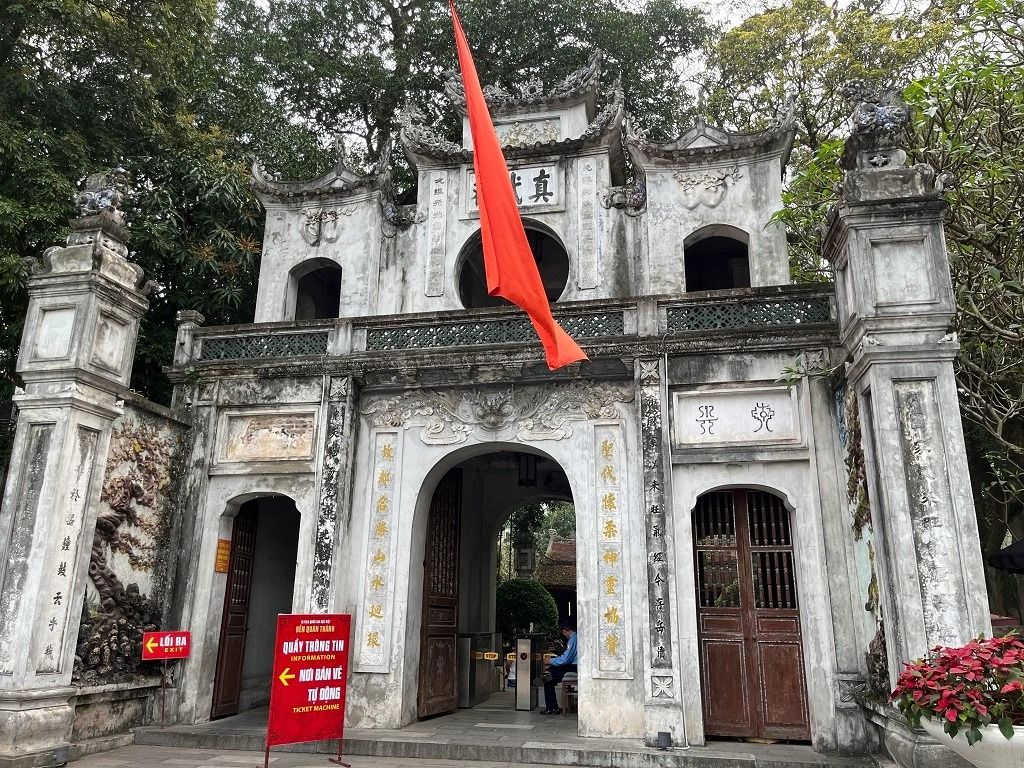
You smell it before you see the gate — incense smoke drifting out over Thanh Niên Street, mixing with the specific damp-lake smell that hangs around this whole stretch where West Lake narrows into Trúc Bạch. Quán Thánh sits right at that junction, unassuming from the road, easy to walk past if you're focused on the lake view instead of the temple wall beside it.
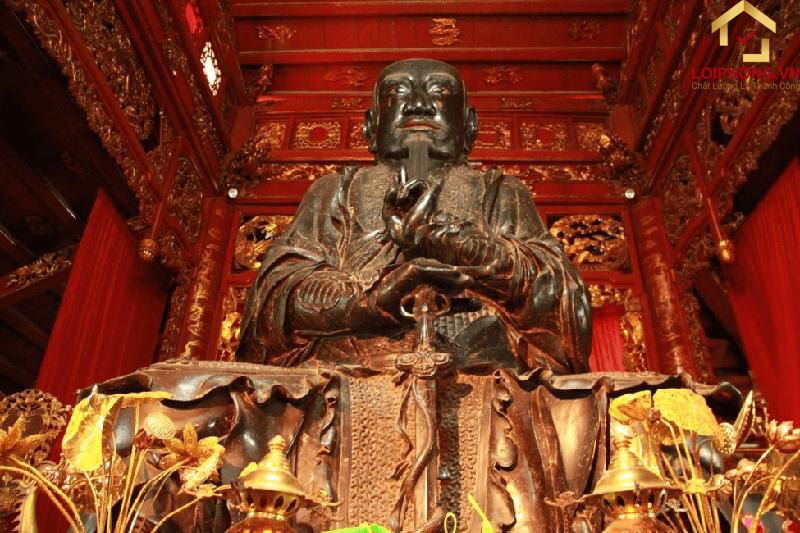
Inside, past the outer gate and a modest courtyard with old banyan and frangipani trees, is the reason this place has mattered for a thousand years: a black bronze statue of Huyền Thiên Trấn Vũ, cast in 1677, standing just under four meters tall and weighing around four tons. He's depicted barefoot, hair loose, holding a sword with a snake coiled around the blade, one foot resting on a turtle — imagery tied to his role as a guardian deity controlling evil spirits and, symbolically, protecting the northern approach to the old capital. The casting technique alone is worth standing in front of for a minute; this is Later Lê Dynasty bronze work, and it's held up in a way that a lot of contemporary metalwork hasn't.
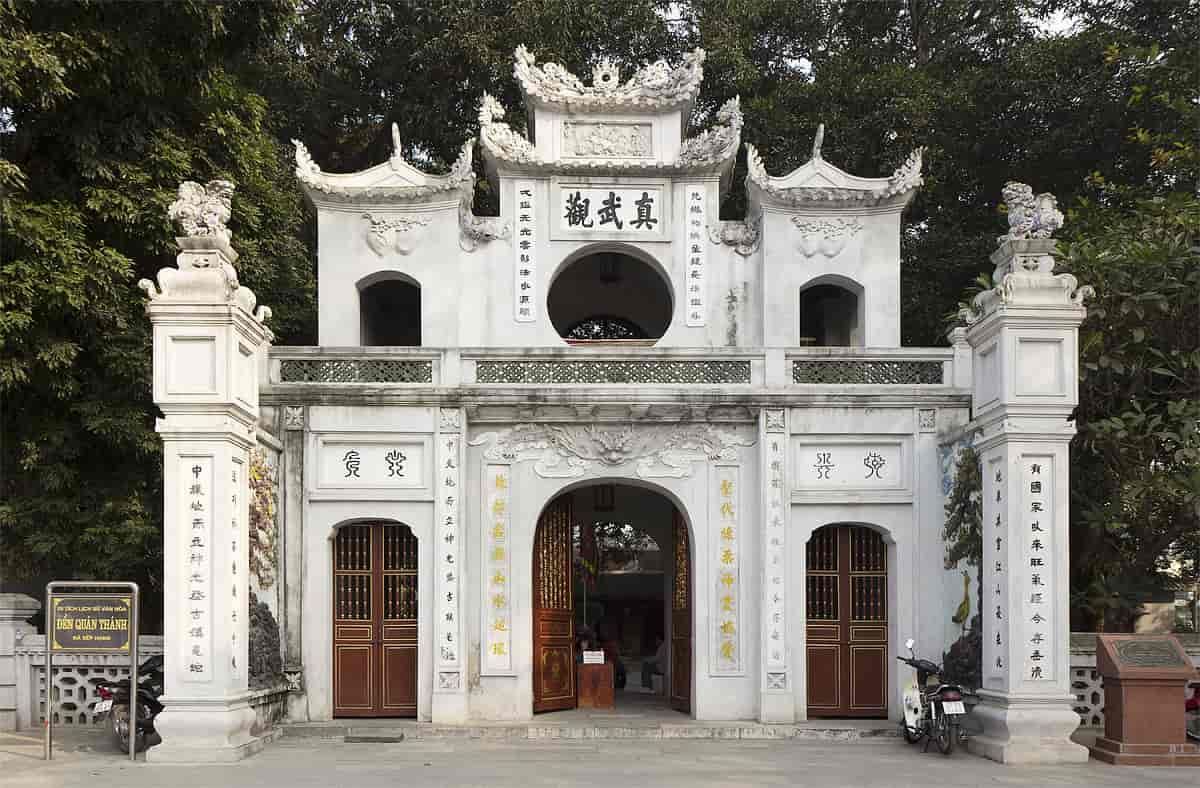
Quán Thánh was originally built in 1010, the same year Emperor Lý Thái Tổ founded Thăng Long as the capital, which makes it as old as the city's founding myth itself. It's one of the Thăng Long Tứ Trấn — the Four Sacred Temples said to guard the ancient capital's four cardinal directions — with Quán Thánh covering the north. It's been renovated repeatedly since, at least seven documented times between 1618 and 1941, so what you're looking at now is a layered restoration rather than an untouched original, which is true of almost every old wooden temple in northern Vietnam. Wood doesn't survive a thousand humid years on its own.
When to go
I like it early, not long after opening, when the incense smoke from the first visitors of the day is still hanging low in the courtyard and the light coming through the gate is soft rather than flat. It's a working temple, not a museum piece behind glass, so you'll usually find a handful of locals there lighting incense and quietly going about actual devotional business rather than posing for photos — worth being mindful of that and keeping your voice down, camera lowered until you've got a feel for the space.
If you want to see it at its most alive, come on the 1st or 15th of the lunar month, when it gets noticeably busier with local worshippers, or during the temple's main festival around the third lunar month, when there's more ceremony and color to the place. Otherwise it's a genuinely calm stop most of the year, one of the quieter religious sites this close to the center of the city.
Practical details
It's located at the end of Thanh Niên Street, Quán Thánh Ward, Ba Đình District, right where the road splits the lake in two. Regular hours run 8am to 5pm; on public holidays it opens earlier and stays open later, roughly 6am to 8pm; on Lunar New Year's Eve it stays open all day and into the night. Entrance is 10,000 VND for adults, 5,000 VND for children — cheap enough that it's easy to justify even a quick fifteen-minute stop.
Pair it with a walk along Thanh Niên toward Trúc Bạch or over to the West Lake shoreline, and you've got one of the better half-hour detours in that part of the city — the kind of quiet, unhurried stop our photo walks around West Lake tend to build a little extra time around, since the light off the water right by the temple gate is worth waiting for.
Turning the Trip Into a Shoot
The easiest place for a private photo walk is Day 1 morning, when the route already moves through varied Old Quarter and French Quarter textures.
TravelFrame's working experience combines a local companion, route planning, gentle posing support and photography. Exact package, duration, delivery and price are confirmed in writing.
Visit TravelFrame or message PHOTO to @travelframe.vn to discuss current options.
Frequently Asked Questions
Is 48 hours enough for Hanoi?
It is enough for a thoughtful introduction to the historic center and one wider neighborhood cluster. It is not enough to see every major attraction.
How should I travel between the Old Quarter and West Lake?
An app-based car is often the simplest option. Check the estimated fare in the app, confirm the vehicle and allow extra time for traffic.
What should I book in advance?
Confirm accommodation and any essential ticketed experience. Re-check official hours for museums, heritage sites and performances near the visit date.
Is this itinerary suitable for solo female travelers?
The route uses central, well-known areas and leaves daylight for most walking. Individual comfort and street conditions vary, so use normal city precautions and adjust any stop that feels uncomfortable.
👉 Want to visit Hanoi's temples and pagodas with a local who photographs you along the way? Join our The Spiritual & West Lake Breeze private tour.